The Context
Pratt & Whitney was founded on July 22, 1925 by Frederick Rentschler in a Hartford tobacco warehouse. A century later, the company is a global leader in aircraft propulsion with facilities on multiple continents and a workforce spread across the world.
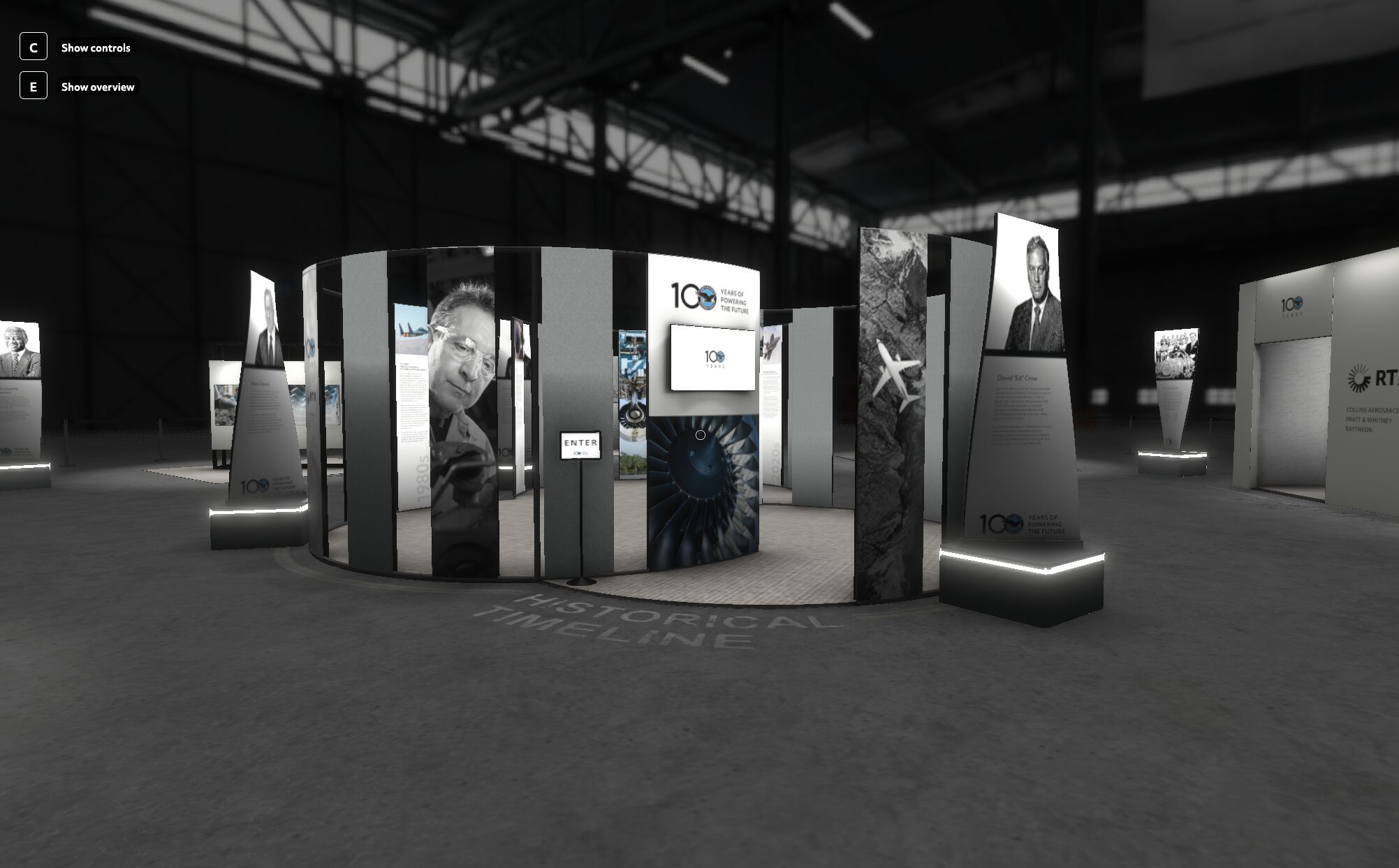
To mark the centennial, Pratt & Whitney built a traveling exhibit touring 11 of its facilities worldwide. But a physical exhibit can only be in one place at a time, and a company operating at this scale has employees who will never be near one of those 11 stops. The solution was a virtual version of the tradeshow: a web-based 3D environment that any employee anywhere in the world could walk through online.
Frontline Productions was brought in to produce the virtual experience, built on PlayCanvas, a web-based game engine capable of delivering real-time 3D in a browser. Fourside Studios was subcontracted to build the 3D models of all nine exhibit booths.
The Challenge
The physical booths were being fabricated by a separate contractor. That contractor had lost the bid to build the virtual tradeshow and declined to share any additional details about the booth designs beyond what was already in circulation.
What Fourside Studios had to work with:
- One single rendering of the physical booth environment
- Adobe Illustrator files for each piece of artwork the designers had created for the exhibit
No dimensions. No construction drawings. No floor plans. One image and a set of flat vector files.
From those two sources, the full set of nine booths had to be modeled accurately enough to serve as the environment for a live, publicly accessible virtual experience.
What Was Built
Dimension Reconstruction
With no measurements available, booth dimensions were estimated using two reference points: the 1:1 scale relationship between the artwork files and the surfaces they were designed for, and standard building code guidelines for commercial exhibit construction. Matching the proportions of the artwork to the surfaces visible in the render made it possible to work backwards to plausible real-world dimensions. The resulting models were built to those estimated specs.
3D Modeling
Nine individual booths were modeled in full, each representing a distinct section of the centennial exhibit. The models were built for real-time rendering inside a game engine, not for cinematic output, which meant geometry had to be clean, efficient, and structured for baking.
Texture Preparation
Each Adobe Illustrator vector file was processed and prepared for use as a game-ready texture asset. Vector artwork built for print does not translate directly to a real-time 3D environment. Each file required conversion, optimization, and UV mapping to sit correctly on the modeled surfaces at the quality level needed for close viewing inside the virtual space.
Asset Baking
Completed models were baked for use in PlayCanvas, a process that pre-calculates lighting and surface detail into the texture maps so the geometry can render efficiently in a browser-based environment without requiring real-time lighting computation.
The Result
The virtual tradeshow is live at pw100exhibit.com. Any Pratt & Whitney employee or visitor worldwide can access the centennial exhibit online, walk through all nine booth environments, and experience the 100-year history of the company regardless of whether they are near any of the 11 physical tour locations.
Nine booths. Modeled from a single render. Built to spec from building codes and artwork scale. Delivered as baked, game-ready assets for a live web experience.
The Takeaway
The ideal production scenario involves complete information. This was not that. The contractor who held the booth specifications declined to share them, and the project moved forward anyway. Reverse-engineering dimensions from a single image and a set of vector files is not the standard workflow. It is the workflow when the standard workflow is not available.
The virtual tradeshow launched on schedule and is live for a global audience. That is what getting the job done with incomplete information looks like.
Fourside Studios served as the 3D production specialist, subcontracted through Frontline Productions.